The Challenge
The Philippines faces a long-standing problem with unsafe public infrastructure, often linked to poor planning and corruption. Across cities, pedestrians encounter broken sidewalks, inaccessible footbridges, tangled cables, and hazardous structures that put everyday safety at risk. These flawed projects have become a visible part of daily life, affecting millions of commuters and pedestrians. Move As One Coalition, an advocacy group promoting safer and more inclusive mobility, set out to confront this issue by exposing the everyday dangers caused by flawed infrastructure. The main challenge was to raise public awareness about these unsafe structures and urge the government to take action. With limited financial resources and only ₱20,000 (USD $300) allocated for paid media, the campaign had to rely on creativity, cultural relevance, and public participation rather than traditional media scale. Another challenge was public mindset. Many Filipinos have grown used to navigating unsafe environments and often tolerate inconvenience and risk as part of daily life. This normalization reduced urgency and made infrastructure failures feel routine instead of unacceptable. The task was to make these dangers impossible to ignore, connect individual experiences into a larger national conversation, and generate enough public attention to push authorities to review, redesign, and improve unsafe public structures.
The Solution
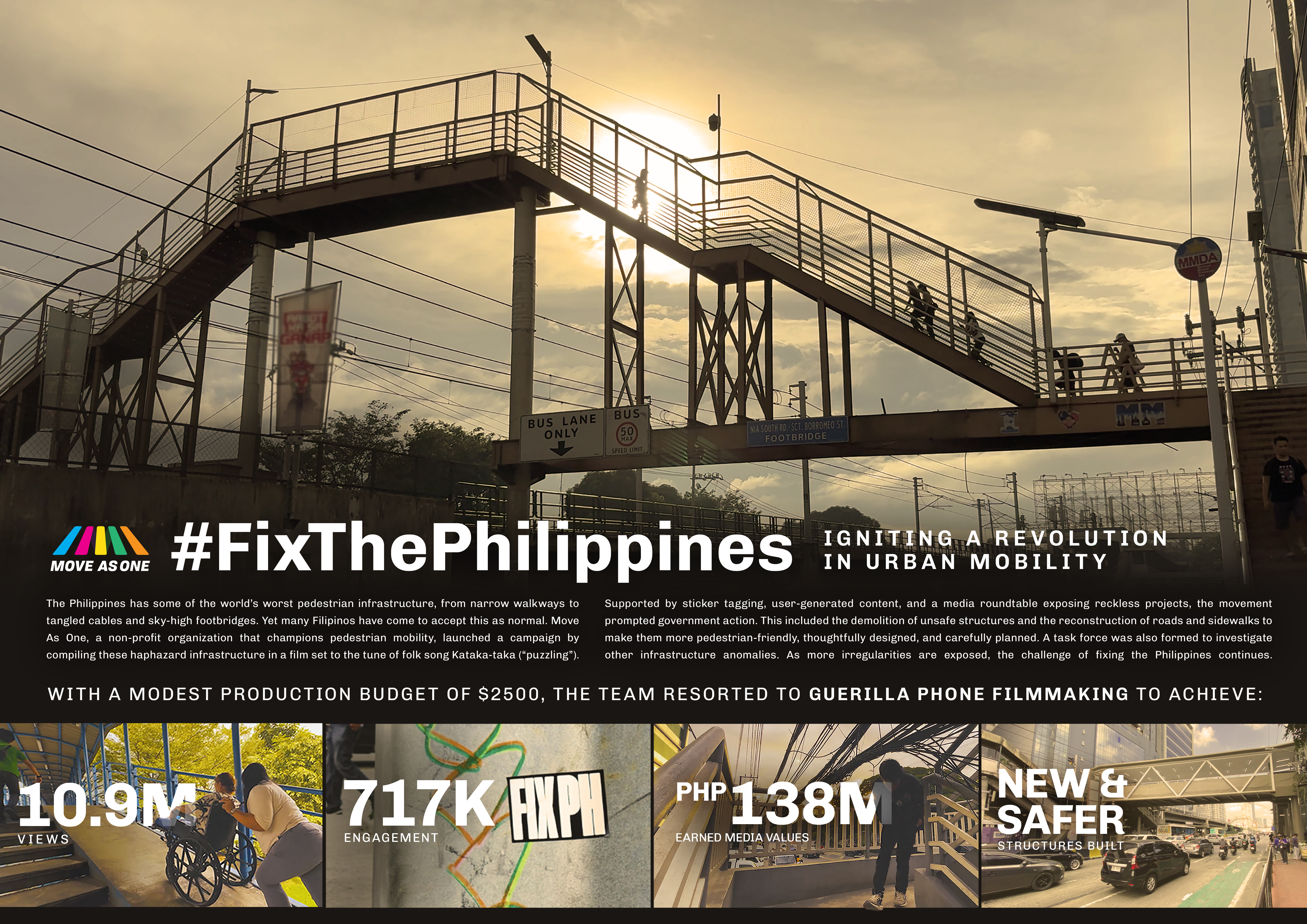
The campaign launched with a hero film that documented the real dangers pedestrians face when navigating poorly designed public structures. The film highlighted how flawed infrastructure, often linked to corruption and poor planning, puts ordinary citizens at risk. Released on social media, it served as the foundation for public discussion and awareness. This was followed by a guerrilla-style outdoor sticker tagging campaign. “Fix the Philippines” stickers were placed on visibly damaged or poorly designed structures, physically marking hazards and drawing attention to them in public spaces. To expand participation, citizens were encouraged to document and share similar hazards online. User-generated content and short edit-downs of the film amplified real stories and visuals from across the country, extending the campaign’s reach and reinforcing its credibility. The movement culminated in a live media roundtable featuring advocates, planners, and government officials discussing infrastructure issues and exposing problematic projects. Broadcast on television and covered by major news outlets, the roundtable elevated the conversation to a national level and increased pressure on decision-makers to act. Multiple unsafe structures were inspected and rebuilt with safer, improved designs.