The Challenge
Every summer, New Zealand's telco market transforms into a battleground. Spark and One NZ—the two dominant players—deploy their superior budgets to flood the market with free data, making it nearly impossible for anyone else to compete on volume alone. As the challenger third player, 2degrees faced a fundamental problem: the data giveaway had become purely transactional. Customers saw it as a utility top-up, not an experience. Worse, the category had lost all distinctiveness. Every telco was shouting the same offer, which meant the one with the deepest pockets won—and 2degrees didn't have that advantage. The real insight was behavioral. New Zealanders use phones for fun, escapism, and social connection—yet the category was treating data like a billing detail. Summer is when people are most active, most social, most entertainment-hungry. But telco promos felt designed for the opposite: a one-off transaction, standardized for everyone, devoid of personality. 2degrees needed a way to compete for new customers during the crucial three-month window without just shouting louder about data. They needed to make the data itself an afterthought to an experience people actually wanted to come back to every day.
The Solution
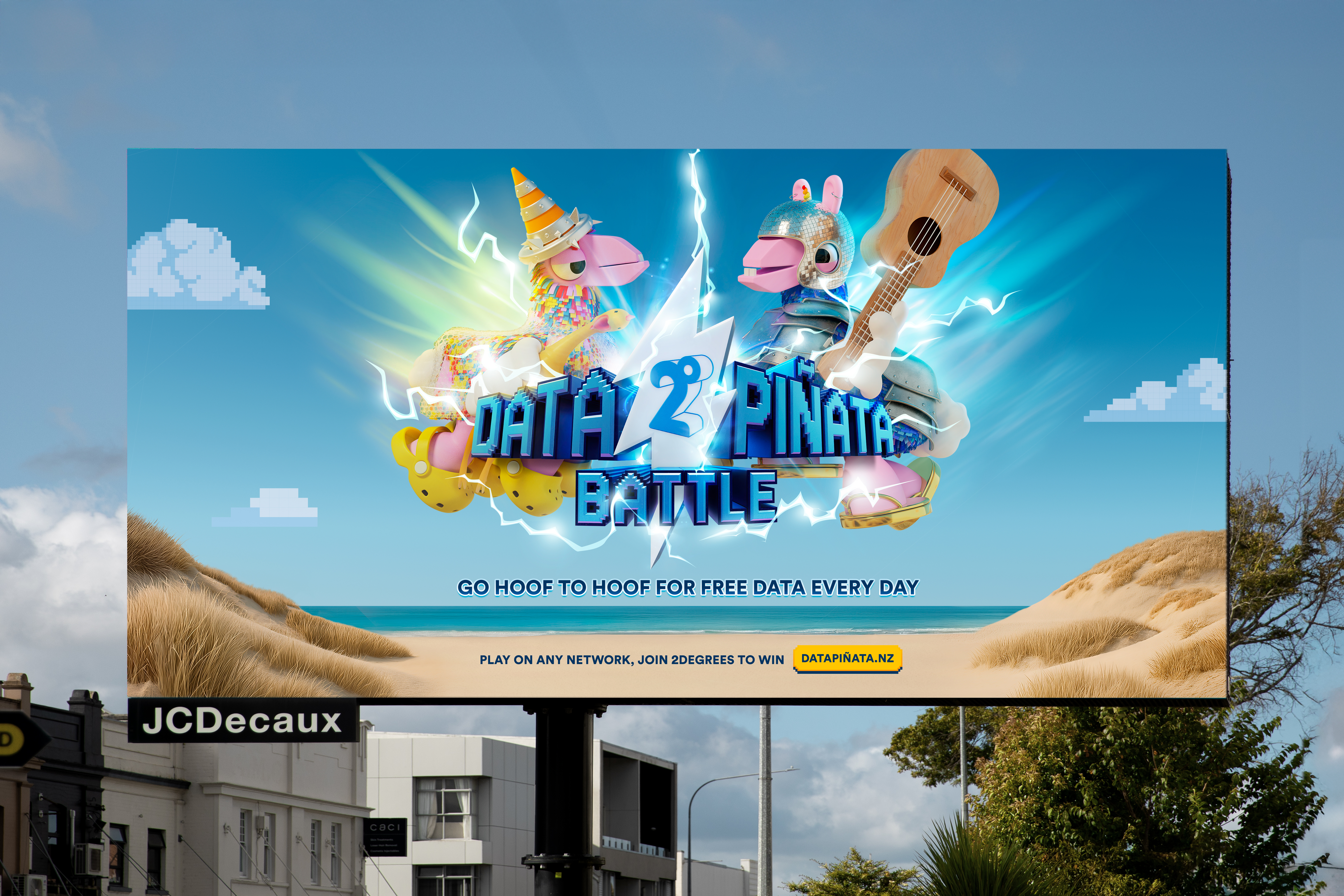
We created the Data Piñata Battle: a mobile game that let all of New Zealand earn free data by battling their mates for it. The brilliance was in the simplicity of the metaphor. Everyone loves smashing piñatas to find prizes—and in New Zealand, "piñata" rhymes with "data," giving the whole thing the perfect amount of silliness. It made it socially acceptable for a telco to tell people to fight their friends for free data. The game was built on four pillars: Personalized: Players named and customized their piñata with armor and loot, making each one uniquely theirs. Social: Build your friend list—including people on other networks—and battle them daily on a leaderboard. The competitive element kept people coming back. Repeatable: Every day brought new opportunities to battle for data and collect loot. Over 80 pieces were available by playing at different locations, times, or during specific weather events. Incentivized for switching: Non-2degrees customers could play and collect data in their "Data Vault," but claiming the prize required making the switch. For existing 2degrees customers, inviting friends from other networks unlocked in-game rewards. Weekly winners were championed in out-of-home placements outside competitors' stores—a subtle flex that reinforced the social victory.