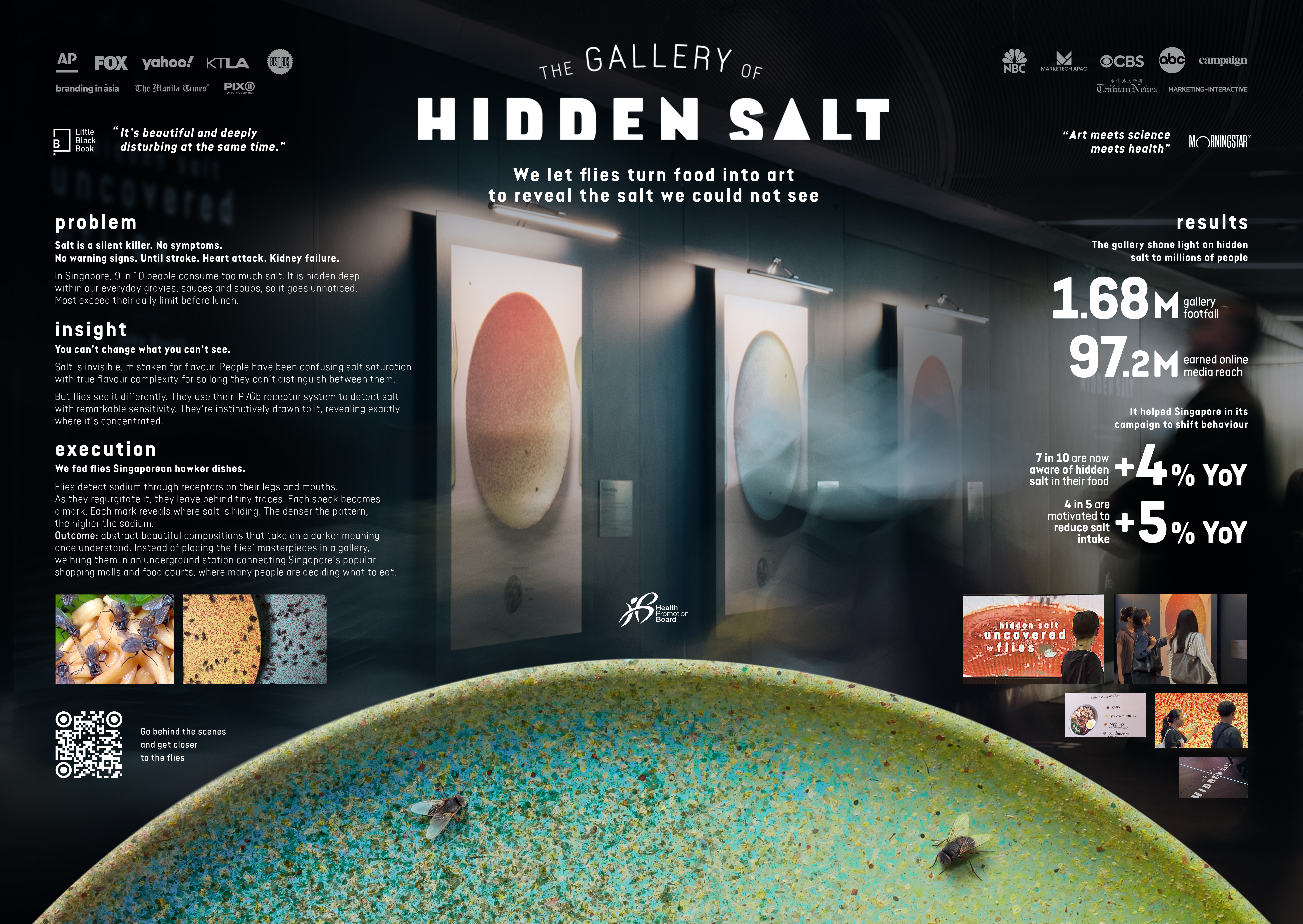
The Challenge
Singapore is recognized as the world’s first “Blue Zone 2.0,” an engineered longevity hotspot where urban planning, healthcare and lifestyle initiatives promote longer, healthier lives. However, in a nation Anthony Bourdain called "possibly the most food-centric place on Earth", with 42 Michelin-starred restaurants and over 250 recognized eateries, Singapore's healthcare and culinary excellence mask a dangerous reality. The data was stark: 9 in 10 Singapore residents consume nearly twice the World Health Organization (WHO)’s recommended daily sodium limit, and more than 60% of sodium intake comes from the 'hidden salt' in sauces, gravies, and soups added during food preparation. It's a public health crisis dressed up as comfort food. Sodium adds up quietly, dulling taste buds over time and making you equate saltiness with tastiness - then bang, you're dealing with a stroke or a heart attack. In Singapore, 1 in 3 are already suffering from hypertension. So the Health Promotion Board of Singapore (HPB), a government statutory board under the Ministry of Health, needed to address this public health issue. What was interesting about working with the HPB team was that they didn't want another statistics-heavy ad or a guilt-tripping PSA. They wanted something that would change how people saw their food. Task: How do we make Singapore residents aware of ‘hidden salt’ in their food? How do we make the invisible visible?
The Solution
The work was driven by a simple but critical behavioral insight: people struggle to manage sodium intake because they lack the physical ability to recognize how much sodium they consume. Over 60% of Singapore’s sodium intake comes from “hidden salt” in sauces, gravies, and soups added during preparation. How can we fight what's invisible? With taste buds dulled by prolonged sodium overconsumption, even our tongues can no longer detect excess salt. Instead of statistics or warnings, we used flies’ natural sensitivity to salt, translating invisible data into physical patterns and turning everyday foods into visual maps of sodium concentration in different parts of the dish. Presented as an art gallery, the work invited curiosity rather than resistance. Familiar foods were reinterpreted in unexpected ways, encouraging people to look closer and rethink what they consume.